What Crows Eat
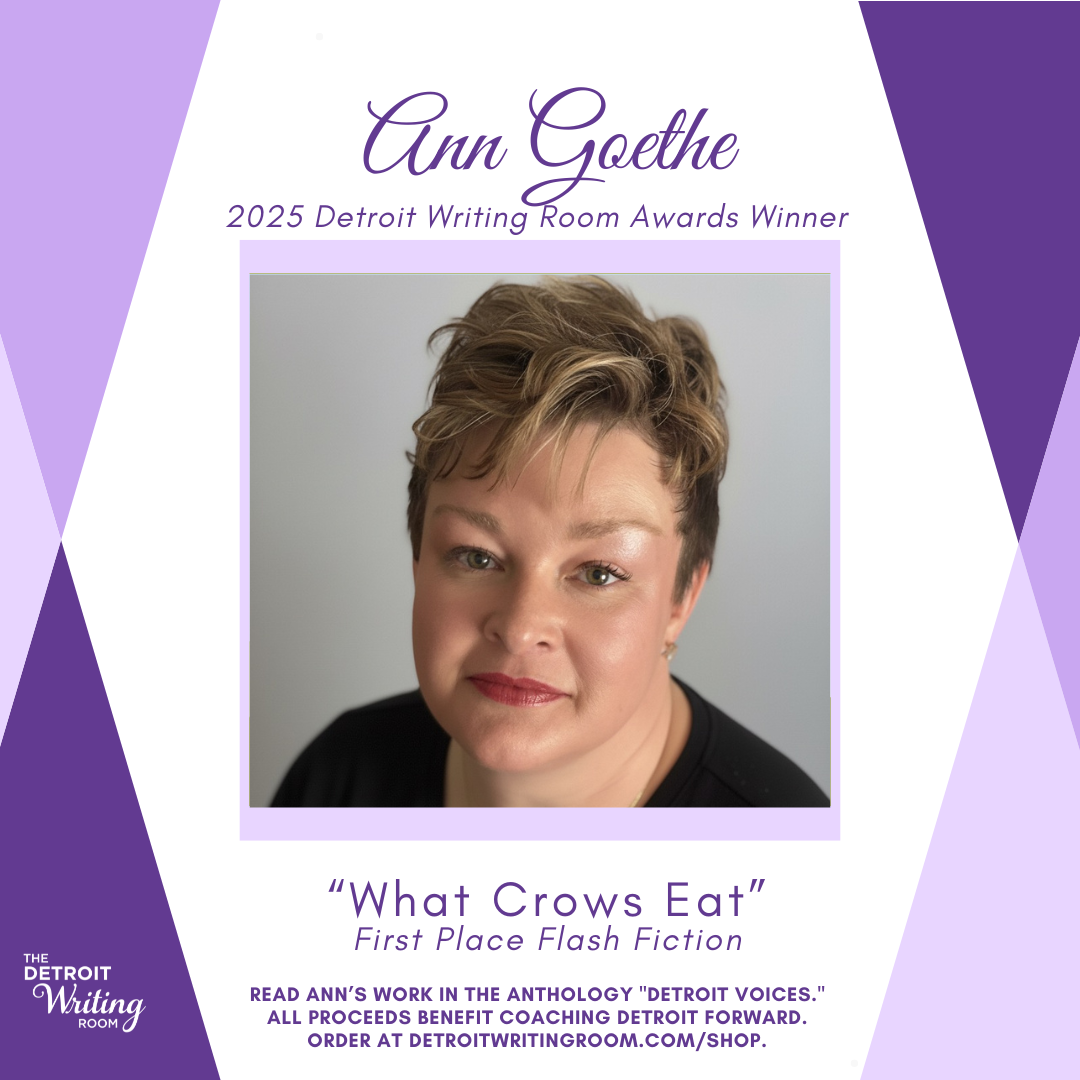
By Ann Goethe
Lana stepped outside with a click of the door. She could not, must not, wake her family. Goosebumps slid across her arms. Her dress, thin from wearing and washing, did little more than cover her body. She nearly ripped it to shreds after her brother said he liked it. But aware of money, always aware of money, she kept it. Would she wear it again tomorrow?
The night came to life in a chorus of sound. Crickets sang, owls hissed, branches cracked. A shooting star tore across the sky before vanishing — seeking a beginning or an end. Not all fantasies could be named light or dark, just as motives didn’t always reveal themselves as pure or wicked. Some lingered, tangled in shadow, waiting to be understood.
Footsteps. “Lana,” a voice said. His voice, too loud for the night, but oddly sweet.
“Shhh.” She held a finger to her lips, fearing someone might hear. What explanation could they give for meeting like this?
He found her on the porch. They stood as close as lovers, and she knew he wanted to touch her. She grabbed his hand then and ran across the pebbled driveway. The moon gave only a crescent of light, but Lana didn’t need it. Every tree, every bush, every corner was long seared into her memory.
They pushed the farmhouse behind them and stopped near the cornfield. The grass grew in thick emerald patches, cradling their steps. She dropped his hand and thought here.
“You OK?” he asked, voice hushed.
She saw the outline of his face, the strong jaw and well-shaped nose. From an upstairs window yesterday, she’d watched him work, his muscles flexing, skin gleaming with sweat. He’d caught her gaze and waved. She had backed from the window without raising her hand, but that moment when their eyes met stayed with her. She’d felt a jolt of recognition, as if a hidden thread bound them in ways she did not understand.
Now, they were alone. No window separating them, no farmwork demanding their attention. “I’m fine. I like this spot. It’s…”
“Secluded.” He acted like he understood but couldn’t possibly. All he saw was the cheap dress and pale limbs. He’d soon learn she was not like other girls, wreathed in smiles and bows. Eager for a kiss or caress to confirm her allure.
She craved nothing more than revenge. A way to free the phantoms in her mind.
He laid a blanket across the grass. Lana sat with her legs outstretched and kicked off her shoes, cool air swirling between her toes. He tilted his face to the black velvet sky, relieved only by pinholes of light. “It’s beautiful here.”
Lana looked at her father’s barns, leaning from a seemingly crushing weight. Without turning to look, she knew the house needed new siding. A new roof. New windows. “I see no beauty.”
“Cities are fine, but here, the sky looks clear as water. The air is fresh. Trees stand like soldiers protecting their home.”
Lana had never traveled farther than the village. She slipped her hand inside a cleverly sewn pocket. The switchblade was there. The trees didn’t protect me, she thought, and they won’t protect you.
“Tell me what your life is like,” he said.
Adrenaline already surged as strong as blood. She fought to keep her voice steady. “You’ve seen for yourself.”
“I’ve been here six days. I’m just passing through.” He plucked a blade of grass and rolled it between his thumb and forefinger. “What do you do each day?”
Lana thought about her life and how it must look to an outsider. The drudgery of working and wearing a grubby apron. Sometimes she rubbed olive oil into her hands to soothe the chafed skin. “I cook. Clean. Take care of my mom.”
“She…”
“Had a stroke.”
“Your father is a kind man, but your brother doesn’t seem as generous.”
My brother visits my room at dawn, Lana imagined saying. He says he loves me like a wife, that he can’t help himself. His touch is rough, demanding, possessive. After he leaves, I take a cold shower to clear my head. Then I go downstairs and act like a normal daughter. But I’m not normal. How can I be when everything I do, everything I say is a lie?
“I’d leave in a heartbeat.” Lana heard the bite in her words. It didn’t matter. Any minute now, he would draw his last breath. She would return to the house, her secrets her own, while the crows feasted on his flesh.
A cloud crossed the moon. He lay back, fingers laced behind his head. Her grip on the switchblade tightened. She imagined plunging it into his flesh, pushing deeper until his blood stained the handle. Every man is the same, she thought. They don’t care if a woman says no, if she cries in the night, if she’s so repulsed by her skin that she scrubs until it’s raw.
Lana pulled the knife from her pocket. He’s a drifter, a tumbleweed in the wind. If somebody asks about him, I’ll shrug my shoulders. What do I know? I’m just a woman with a body, no brain or heart or soul.
She pushed the knife lever. The blade sprang to life.
Now.
“‘The moon, like a flower, in heaven’s high bower, with silent delight, sits and smiles on the night.’”
Lana could have recited the poem’s next lines: ‘Farewell, green fields and happy grove, where flocks have took delight.’ She pushed the blade back into the knife and imagined a quizzical look on Death’s face. Are you going to do it or not, the creature might demand.
“What did you say?” Lana asked Beau, the man beside her. A man in work boots and torn jeans who, at first blush, did not look like a poetry student.
“It’s the first stanza of a poem. Night, by William Blake.”
She returned the knife to her pocket and drew a shaky breath. “My mother used to read that poem when she tucked me in. I haven’t heard it in years.”
“You know Blake? I’ve written a few verses. Maybe you’ll read them sometime.”
She placed her hand on the blanket, free of the switchblade, free of malice. If she took his life, what came next? Guilt? Madness? How many men might she lure into the night, promising bliss but unleashing a fury only the devil could understand? Still her brother would continue, his sickness poisoning the ground and air and even the trees so that everything reminded her danger lurked in the dark.
Maybe she hated the night. If that was true, there, on the farm, she hated both night and day. But Beau had nothing to do with it. Nothing at all.
He wasn’t the one who hurt her.
“I think I escaped a terrible fate,” she whispered.
His fingers brushed her cheek. “Leave with me. I’ll show you the world, or we can build a cabin in the woods. Whatever you want.”
“Don’t say things you don’t mean.”
“I never do.” He leaned forward. Slowly, taking his time, allowing her to run if she wanted. She stayed, and their lips met. Close-mouthed. Hearts drumming. Breathing as one. A choice had to be made. They could stop and linger in a moment as innocent as a children’s story. Or they could venture further and test the passion they’d unearthed.
The decision took seconds to make. Lana slid her arms around his neck and moved her mouth with his. Her hands wandered down his back as he pressed into her. She ached for more, but not here.
Not here.
She ended the kiss but stayed near, allowing him to hold her. I could love this man, she thought. I could love him, and he could love me, under the same sky in a different place. I’ll wear a new dress and new shoes, and my hair will shine in the sun.
“I’ll go with you,” she said. “Tell me when we leave.”
“Now. We’ll catch a bus at dawn.”
Dawn. When the sun rose, Lana wouldn’t be in bed, listening for her brother’s footsteps. She wouldn’t watch him open the door, step inside her room, and whisper in a thick, desperate voice, “I need you.”
She shuddered.
Beau’s arms tightened. She melted into him, but gnawed on a new worry. If this moment passed, she would lose the opportunity to tell him about herself. And in time, maybe a month, maybe ten years, something dark and eager would slip between the cracks and pry her away from him.
She looked into his eyes. “Things happened here. Terrible things. Happiness seems impossible, but I promise to try.”
Beau brushed the hair from her forehead. “I know. I killed your brother. His body’s a few miles down the road, near a tree. Good food for the crows.”
1st Place Flash Fiction
Read the piece in “Detroit Voices” featuring the 2025 DWR Award winners.
Ann Goethe writes about magic, love and the intersection where human folly meets choice. One day, she hopes to give these stories her undivided attention, but until then, she writes when time allows. Home is in Michigan with her four dogs. She loves cold weather and iced coffee and is currently working on a romantasy novel.