Mother’s Day, 2018
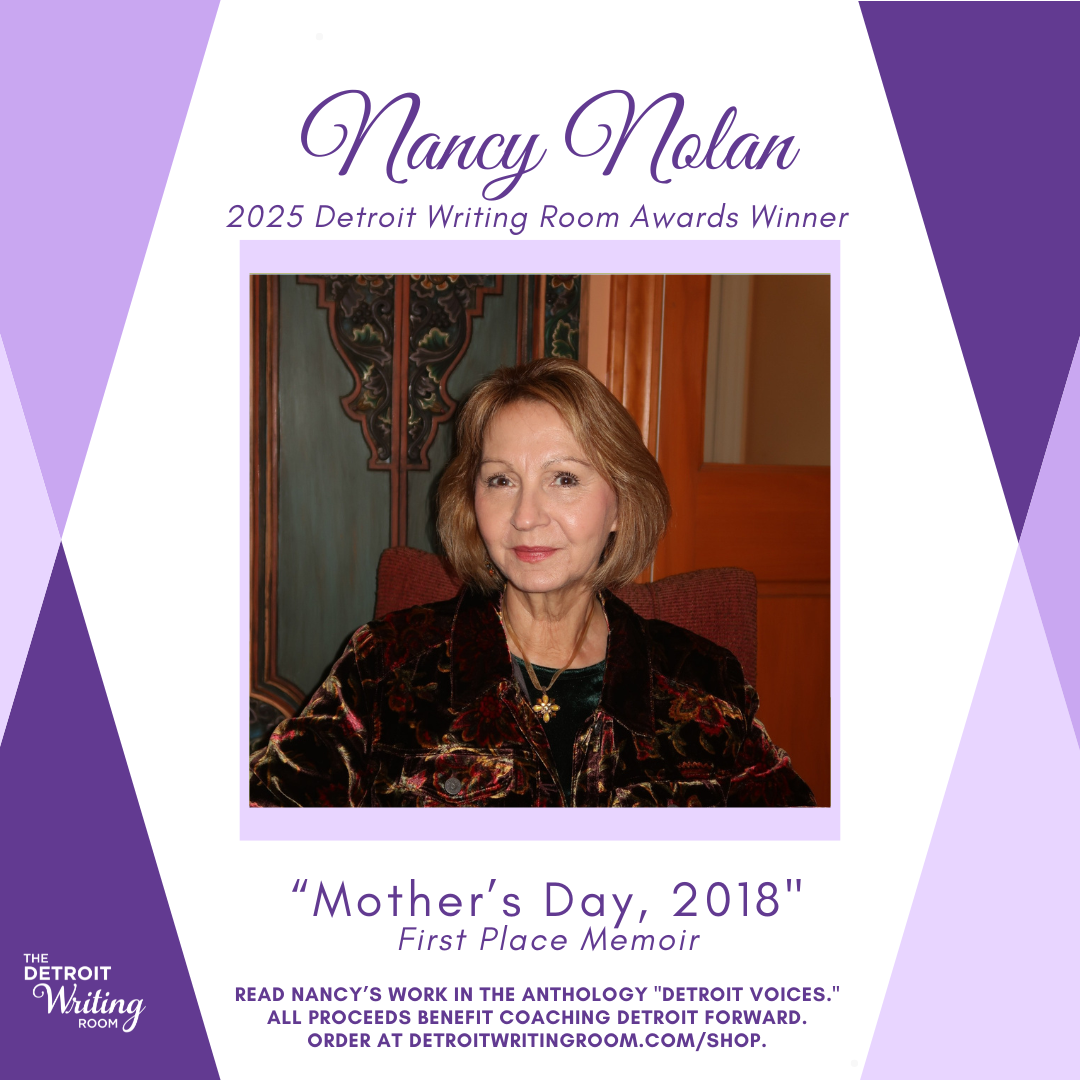
By Nancy Nolan
It is a labor of love. We are sorting through family albums and boxes of photographs, choosing the best ones to showcase Dayna, our youngest. Her high school graduation is coming up in June, less than a month away. We’re planning a big party to celebrate her accomplishment. The house is filled with excitement and laughter.
Among Dayna’s adorable baby pictures and colorful childhood snapshots, out slips a lone black-and-white photo, decades old. I pick up the faded face that gazes up from the floor.
My mom. She displays a beguiling smile. She’s looking off to her left, as if someone out of the picture has just said something witty. She looks lit up from within. It was taken long ago, probably when she was in her late teens. Before her life was set in stone.
Our firstborn, Rory, walks by. As he passes, he peeks over my shoulder. “Who is that again?”
I struggle to find the right words.
He shrugs and walks on. He’s never met her, of course. Still, his question makes me wince.
***
Mother’s Day arrives a few days later, in its usual fluttery, breezy way. The trees have grown flowery and puffy, and the sun shines just strong enough to warm the air. And inevitably, I get that familiar worry.
I walk past the pastel displays at Rite-Aid, made for someone else’s life. I catch a glimpse of another woman’s face. She’s clearly avoiding eye contact as she hurries past all the Hallmark sentiment. I bet, like me, she no longer has a place at this table. Her downcast expression tells me that we are members of the same club. Even after all these years, I still feel a little sorry for myself. Today, I extend the feeling to my Rite-Aid comrade. Let’s allow ourselves a little wallow in that pool of hurt, shall we? We’re not hurting anybody else.
For the moment, I forget that the cards could be for me. I may be a mom, but I don’t have a mom. Not anymore. When I first decided to have children, becoming a mom with my own mom long gone — well, it felt like the height of foolishness. Like an ill-advised dare of sticking your hand in a dark box and having to determine, from touch alone, what you will end up with. Spaghetti, or worms? Thankfully, it worked out. But Jesus, the uncertainty of it all.
My familiar worry? More of a panic, really. It’s that I may have forgotten my mother.
I have now lived significantly longer on this Earth without her than with her. The specifics with her have faded: the places, conversations, dates…until now, I’m left with more of an intangible feeling of her than anything else, as if she’s receded behind a wispy curtain of cotton gauze.
Walking home, I search my mind…grasp onto something. Let’s see…There was a soft tummy in a lap that rounded up to cushion my pointy elbows and knees of childhood. There was that beautiful voice from the basement, singing to the washing machine when she thought no one was home.
There were no hard outlines with her — she was all curves and contours. No career clothes or angled bobs; she had baby down for hair. She was forever uncertain, with frequent stolen glances toward the door or windows. If you watched her long enough, you’d wonder what it was that she thought might happen at any second. Her face looked severely fatigued from lack of sleep. Her rabbit-fur gray eyes matched the color of the hollows underneath them. Weren’t her eyes blue before? I know they were when she was young…
But the main way we could tell Mom had been there was by the absence of things. The dirt was gone from the floor. The wet towel you dropped in the bathroom was picked up and laundered. Everyday meals were mostly a blur of simple sustenance, but the hunger that had driven you home was quieted. The hole in your shirt was magically stitched up, the jagged edge now a barely perceptible line.
Most of all, Dad wasn’t angry anymore. He wasn’t exactly calm, but the intensity was gone, and the shards of smashed dishes were swept up out of sight, into the trash. And the trash was removed.
Her name itself was a blend of unobtrusive vowels and soft consonants. Evelyn. “Even Evelyn.” My dad used to shorten even that, so she became one-syllable “Ev.” Not Eve, Ev.
The story of her life is what she did for others. The smoothed-over feelings, the sting soothed after a fall off your bike, the monsters shooed away from under the bed. For women of her time, that was supposed to be enough.
In a moment of candor, my brother once told me that when he was a teenager, he had a certain sock that he hid under his bed. He’d regularly find it replaced with a clean one. No discussion. No other indication that she had been there.
One thing about her that did have a very strong presence: the shame that sat on her shoulder like a second head.
After my mother died, my grandmother, who ended up outliving her by two years, told me a story about her. Mom used to play basketball when she was a teen, which always surprised me, as I never saw her doing anything athletic. She had wanted to look pristine for an upcoming game. But she was ashamed of her old, stained socks. To whiten them, she put them in boiling bleach water on the stove. She stirred and stirred until the heat and bleach ate through the cloth. She had no other socks to wear so the coach wouldn’t let her play. My grandmother told it as a funny anecdote, giving it what she hoped was a light touch of eccentricity. But I could feel the pain in it.
Shame twisted everything around for her, pointing whatever ugliness in her world inward. When she had become unmistakably buxom at a very young age, she used to bind her D-cup breasts tightly against her chest because, she told me, she “didn’t want the men looking at me like that.” As if it were her flaw. Later on, it is what made her eat her way into obesity and kept her confined within the walls of our home.
She became a mother relatively young, and then that was who she was. As the fourth of five kids, with six, eight, and ten years between me and my older brothers, she seemed a bit worn out by the time my younger brother and I came along. It was a very “guy” household. To me, it seemed like not much thought was put into where she fit in, other than the tasks to be done.
Mom’s heavy sighs expressed volumes of disappointment, of anger, of giving up…we had to guess what they meant. There was an ever-present hesitancy in her voice. You knew she was always holding back. She was the smartest person in the room, but you had to be a detective to see it.
I know that secret Oppressive Editor. He’s the one who holds back the intensity. A superego with an attitude of superiority, a know-it-all who convinces you that your intended statements are surely lame eye-rollers and you are about to embarrass yourself no matter what:
Tone it down. You should live in the space between things. Leave room between you and others. That’s a want, not a need: Make do with what you have. You show too much of your gums when you laugh. And laughing like that? That’s unladylike.
I resented the censorship. I’ve learned to shake that O.E. off, to rebel, even to laugh about it occasionally. “If I were me right now,” I sometimes ask myself, “What would I do?”
But her O.E. — he decided her entire life for her. He deemed what was too much of her to show. It begs the question: What of her was left on the cutting room floor?
I was nineteen when she was diagnosed with breast cancer. She was fifty-three, though if her doctors had listened to her, she could’ve been diagnosed at least a year earlier. They minimized her concerns, and thus, likely, her life. I don’t know how accurate this is, but my memory is that she just got sicker and slowly wasted away for the full six years until she died at age fifty-nine. When the life seeped out of her at the hospital, I saw her slip away. I was in the room. I watched her eyes become lifeless, the whites sinking slowly back into her head. This most awful, painful, searing image haunted my nights for years.
But it felt disturbingly familiar, sadly inevitable, to watch her recede.
I don’t know if we ever really had her.
My mom was one of those people who need help to be remembered. The ones who squish themselves against the side of the bus when you sit in the seat next to them. Who quietly walk off the plane with a secret imprint on their thigh from wedging against the furthest armrest. You don’t even think about all the room she gave you.
It’s weird how a person exists: a body in a seat, a signature of speech, a sound of light footsteps, a hope, pregnant with possibilities. And then she’s gone.
A whole presence is now the past. The only thing that is now real is an intangible memory, a filmy ghost in our heads. That she ever lived at all is hard to prove. Unless you create while you’re here, once you’re gone, it’s hard to prove you ever were.
I take the faded picture and display it prominently on the mantle. I vow another walk up to Rite-Aid first thing in the morning to get that solid wood frame I had lingered over. She will reign over the celebration of joy and accomplishment of her granddaughter’s graduation. I will make sure everyone sees her.
“Remember you asked about this picture?” I say to my son. “That’s your grandmother, honey. It’s just an early picture of her. Look closely at her eyes. Do you see the resemblance? She looks like you.”
1st Place Memoir
Read the piece in “Detroit Voices”featuring the 2025 DWR Award winners.
Nancy Nolan grew up in Detroit, moved away and back several times and now lives in Huntington Woods, Michigan. She obtained her master's degree in social work from the University of Michigan. Her career led her to practice in Detroit, London, Oxford and Dublin. Along the way, a holiday romance with her Dubliner Sweetheart ripened into their marriage of thirty-plus years. They have two children. Nancy has always loved to write, but has only recently gotten brave enough to let others read her work. She values her lifelong commitment to volunteer activism. On weekends, she can often be found at a rally or kayaking on Lake Huron.